
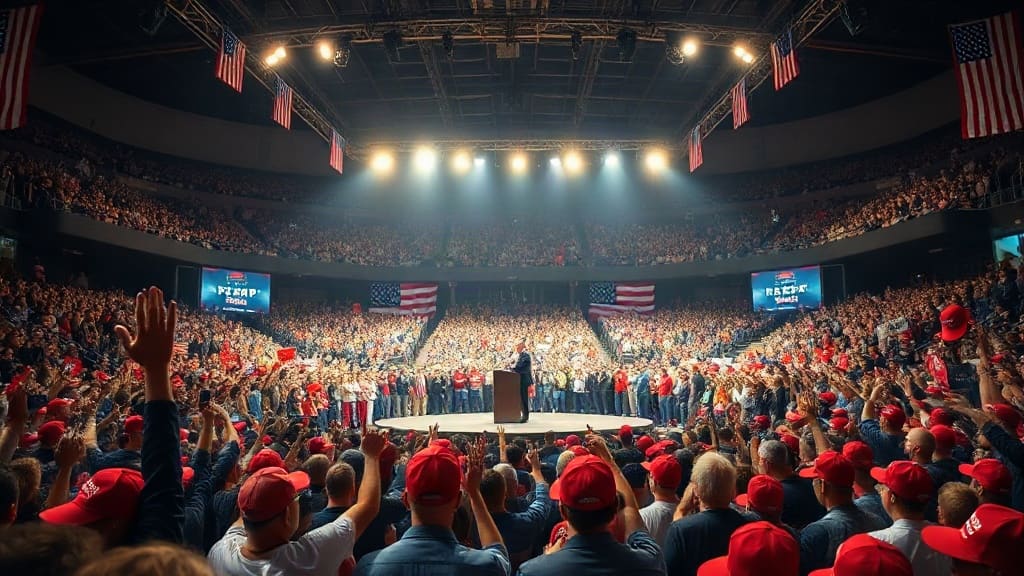
In a packed arena in Wilmington, North Carolina, former President Donald Trump took the stage on a balmy Friday evening, basking in the adoration of thousands of fervent supporters. The event had all the trappings of a Trump rally: the red hats, the chants of "USA," and the familiar litany of grievances and boasts. But with the midterm elections looming, the question on many minds is whether this spectacle of devotion can actually translate into electoral success for Republicans in the tight races that will decide control of Congress.
Trump's visit to North Carolina, a state he won in 2020 but where Democrats have made inroads, underscores the strategic dilemma facing the GOP. The former president remains the most potent force in Republican politics, capable of drawing massive crowds and generating intense media coverage. Yet his appeal is largely confined to a base that is already deeply loyal. The voters who packed the arena in Wilmington are not the swing voters who will determine the outcome in places like Pennsylvania, Georgia, and Arizona. They are the choir, and Trump is preaching to them with gusto.
The Base-Only Strategy
For months, Republican strategists have debated whether Trump should focus on turning out his base or broadening his appeal. The former president has clearly chosen the former. His speeches are tailored to his most ardent fans, filled with red-meat issues like immigration, crime, and cultural grievances. He rarely misses an opportunity to settle old scores, whether with establishment Republicans or the media. This approach energizes his core supporters but does little to persuade independents or moderate Republicans who may be put off by his combative style.
In North Carolina, Trump spent little time discussing the actual Republican candidates on the ballot, instead using the rally as a platform to relitigate the 2020 election and hint at a 2024 run. His message was less about the midterms and more about himself. That may fire up the crowd, but it leaves candidates in competitive districts to fend for themselves. Trump's midterm strategy appears to be less about winning seats and more about maintaining his grip on the party.
This base-first approach carries risks. In 2018, Democrats flipped 40 seats in the House, largely by winning over suburban voters who were turned off by Trump's rhetoric. In 2020, Trump lost the presidency despite record turnout among his supporters because he failed to expand his coalition. The same dynamic could play out in 2022: Republicans may win the turnout battle among their base but lose the war for the middle.
The Battlegrounds That Matter
While Trump was rallying in North Carolina, Republicans in other key states are fighting for their political lives. In Pennsylvania, Senate candidate Mehmet Oz is locked in a tight race with Democrat John Fetterman. In Georgia, Herschel Walker faces a runoff scenario against incumbent Raphael Warnock. In Arizona, Blake Masters is trailing Democrat Mark Kelly. These are the races that will determine whether Republicans take back the Senate. Trump's rallies in these states have been infrequent, and when he does appear, his message often overshadows the candidates themselves.
Consider Georgia, where Trump's obsession with debunking the 2020 election results has alienated moderate Republicans and independents. His attacks on Governor Brian Kemp and Secretary of State Brad Raffensperger, both Republicans who refused to overturn the election, have divided the party. Walker, a first-time candidate, has struggled to unite the GOP base and reach out to swing voters. Trump's rallies in Georgia have done little to bridge that gap; if anything, they have reminded voters of the intraparty feud that could cost Republicans a crucial Senate seat.
In Pennsylvania, Oz has tried to distance himself from Trump on some issues, but his association with the former president remains a double-edged sword. Trump's endorsement helped Oz win a crowded primary, but it may hurt him in the general election, where moderate voters in the Philadelphia suburbs are key. Trump's rally in the state earlier this year drew a large crowd, but it also prompted a wave of negative ads tying Oz to Trump's most controversial statements. The dynamic is similar in Arizona, where Masters has embraced Trump's election lies and now finds himself trailing in the polls.
The Enthusiasm Gap
One of the few bright spots for Republicans this cycle has been the enthusiasm gap. Polls consistently show that Republican voters are more motivated to turn out than Democrats, who have been demoralized by legislative setbacks and the Supreme Court's decision to overturn Roe v. Wade. Trump's rallies are designed to capitalize on that enthusiasm, creating a sense of momentum and urgency. But enthusiasm among the base can only go so far if the candidate at the top of the ticket is not expanding the map.
In North Carolina, Trump's rally did little to boost the prospects of Republican Senate candidate Ted Budd, who is locked in a tight race with Democrat Cheri Beasley. Budd, a congressman who won Trump's endorsement, has largely aligned himself with the former president. But his campaign has been overshadowed by Trump's legal troubles and his fixation on the past. Beasley, meanwhile, has focused on kitchen-table issues like inflation and healthcare, appealing to the same suburban voters who have soured on Trump. The race is a microcosm of the national GOP dilemma: a base that is energized but a coalition that is shrinking.
Democrats, for their part, have sought to make Trump the central issue of the midterms. President Biden has repeatedly warned that democracy is on the ballot, and Democratic candidates have hammered their opponents for embracing Trump's election denialism. In some races, that strategy appears to be working. In others, voters are more concerned about the economy and rising prices. The result is a mixed picture that leaves both parties uncertain about the outcome.
The 2024 Shadow
Trump's midterm rallies are also a preview of a potential 2024 campaign. He has hinted repeatedly that he will run again, and his team has been laying the groundwork for a launch after the midterms. The rallies serve as a testing ground for his message and a way to keep his name in the news. But they also create a dilemma for Republican candidates: they need Trump's base to win, but they also need to appeal to voters who have grown weary of the chaos that follows him.
Some Republicans have tried to have it both ways, embracing Trump's policies while distancing themselves from his persona. But Trump makes that difficult. His rallies are as much about him as they are about the candidates, and his endorsements come with strings attached. He expects loyalty, and he punishes those who cross him. That has led to a series of messy primaries and general election headaches for the GOP.
In the end, the midterms will be a test of whether Trump's base-first strategy can deliver victories in a polarized environment. If Republicans win big, Trump will claim credit and cement his status as the party's undisputed leader. If they lose, he will likely blame everyone but himself, and the recriminations will begin. Either way, the show goes on.
Frequently Asked Questions
What was the purpose of Trump's rally in North Carolina?
The rally was aimed at energizing his base and boosting Republican candidates ahead of the midterms. It also served as a platform for Trump to maintain his influence and hint at a 2024 run.
How does Trump's rally strategy affect competitive races?
It can cut both ways. While it fires up the base, it may alienate moderate and independent voters in key battlegrounds, potentially hurting Republican candidates in tight races.
Why are Republican candidates in swing states distancing themselves from Trump?
Some are trying to appeal to a broader electorate, including suburban voters who may be turned off by Trump's rhetoric. However, distancing too much risks losing Trump's loyal base.
What impact could the midterms have on Trump's 2024 ambitions?
A strong Republican showing would bolster his claim to leadership and ease his path to a 2024 run. A poor showing could prompt challenges from other Republicans and weaken his grip on the party.
Are Trump's rallies effective in turning out voters?
They are effective at energizing his core supporters, but their impact on broader turnout is unclear. In 2020, high base turnout was not enough to win the presidency.