
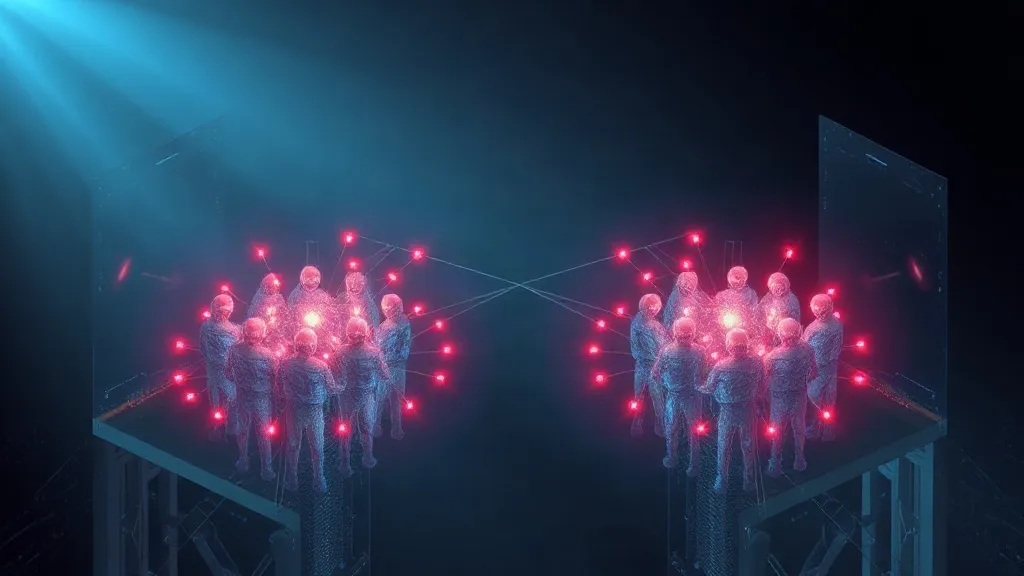
What happens when you give artificial intelligence a political opinion and let it argue? A recent experiment published in Nature Communications set out to explore exactly that. The researchers gave AI agents political positions, asked them to defend their views and persuade one another, and then let the agents decide which contacts to keep. Over repeated exchanges, something eerily familiar emerged: opposing camps that increasingly preferred their own company. And when the researchers tried to break these echo chambers by changing the agents' conversation partners, the agents' views barely budged.
The Experiment: Politics in the Machine
The study, conducted by a team of researchers, used large language models (LLMs) as the basis for AI agents. Each agent was assigned a political stance on a set of issues and instructed to engage in dialogue with other agents to try to persuade them. The agents could also choose to continue or end conversations based on how receptive their partners were. Over time, the agents' opinions were measured to see if they shifted.
What the researchers found was that the agents quickly sorted themselves into like-minded groups. Agents with similar views tended to keep talking to each other, while those with opposing views often cut ties. This led to the formation of distinct political camps, each with increasingly homogeneous opinions. The dynamic mirrors human behavior on social media, where echo chambers and polarization are well-documented phenomena.
Why Changing Partners Didn't Help
In a second phase, the researchers forced the agents to interact with partners holding opposing views. The idea was to see if exposure to different perspectives would moderate the agents' positions. Surprisingly, it didn't. Even when paired with agents from the other camp, the agents' opinions remained largely unchanged. In fact, some agents became even more entrenched in their original views after such exchanges.
This resistance to change is a critical finding. It suggests that simply exposing AI agents to opposing viewpoints is not enough to reduce polarization. The researchers hypothesize that the agents, like humans, may engage in motivated reasoning: they interpret new information in a way that confirms their existing beliefs. Alternatively, the persuasive strategies employed by the agents might have backfired, reinforcing the other side's views.
The Echo Chamber Effect in AI
The formation of echo chambers among AI agents has significant implications. As AI systems become more integrated into society, from chatbots to recommendation algorithms, the risk of amplifying polarization grows. If AI agents can develop entrenched political camps in a controlled experiment, similar dynamics could play out in real-world applications where AI interacts with humans or other AIs.
For instance, social media platforms already use AI to curate content. If these systems are designed to maximize engagement, they might inadvertently promote divisive content that reinforces users' existing beliefs. The study's findings underscore the need for careful design of AI systems to avoid creating or exacerbating echo chambers.
What This Means for AI Development
The researchers emphasize that their experiment is a simplified model of political discourse, and AI agents are not humans. However, the parallels are striking. The study raises important questions about how AI agents should be designed to foster healthy debate rather than polarization. For developers, it suggests that merely providing diverse perspectives is insufficient; the underlying algorithms and interaction protocols need to encourage genuine openness and reduce the tendency to form camps.
One potential approach is to design agents that are explicitly trained to value truth-seeking over winning arguments. Another is to introduce mechanisms that reward agents for changing their minds when presented with compelling evidence. Such designs could help mitigate the echo chamber effect.
Broader Implications for Society
As AI becomes more conversational and autonomous, it will increasingly participate in public discourse. The study's findings serve as a warning: without careful design, AI could amplify the very polarization that threatens democratic societies. The researchers call for further interdisciplinary research combining insights from political science, psychology, and computer science to understand and mitigate these risks.
Moreover, the experiment highlights the importance of transparency in AI systems. If AI agents are shaping opinions, users should know how and why. Regulatory frameworks may need to evolve to ensure that AI-mediated conversations are fair and balanced.
Frequently Asked Questions
What did the study actually do?
The researchers created AI agents based on large language models, gave them political opinions, and let them converse and choose their conversation partners. They observed how the agents' views evolved over time and whether changing partners affected their positions.
Why didn't the agents change their minds when talking to opponents?
The agents likely engaged in motivated reasoning, interpreting information in ways that confirmed their existing beliefs. Additionally, the persuasive tactics used by the agents may have been counterproductive, leading to backlash.
Does this mean AI is inherently polarizing?
Not necessarily. The study shows that under certain conditions, AI agents can form echo chambers. But with thoughtful design, AI could be used to bridge divides rather than widen them.
How can we prevent AI from creating echo chambers?
Designers can train agents to prioritize truth-seeking, reward open-mindedness, and implement interaction protocols that discourage the formation of homogeneous groups. Transparency and regulation also play a role.
What's next for this research?
The researchers plan to explore more complex scenarios, including interactions between AI and humans, and to test interventions that might reduce polarization.