
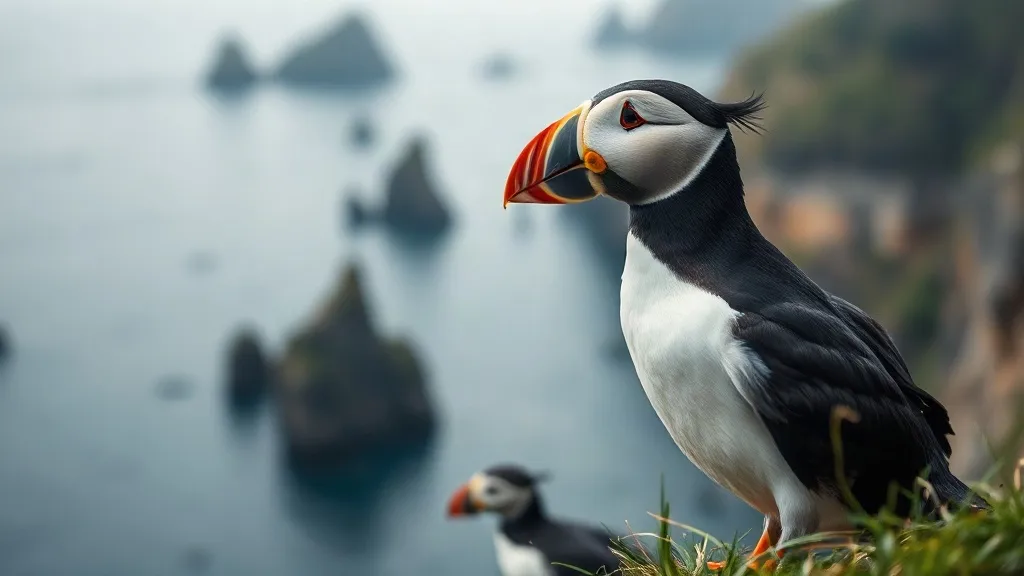
Ask anyone to name their favourite British bird and the puffin will almost always come up. Its face, after all, looks like something designed for a greeting card: a stout black and white body, a rainbow-striped bill and those mournful, slightly painted eyes. It is a bird that makes people smile. And yet the puffin is one of the strangest contradictions in British wildlife, because the creature we think we know so well is one that most of us have never actually met.
That gap between affection and acquaintance is worth sitting with for a moment. The puffin rivals the robin as the country's best-loved bird, appearing on book covers, tea towels and charity appeals, but the vast majority of people who would call it their favourite have never seen one in the flesh. It lives, for much of the year, in a place we cannot follow.
A Bird With Two Lives
For a few months each spring and summer, puffins become colonial. They gather on cliff tops and offshore islands in noisy, crowded gatherings, digging burrows or tucking themselves into rocky crevices, and raising a single chick, known as a puffling. Then, as autumn arrives, the colonies empty. The birds head out into the North Atlantic and spend the winter scattered across open ocean, riding out storms and diving for fish far from any human vantage point.
This double life explains a lot about why puffins feel both familiar and remote. We see them at their most sociable, when they are packed together on land and easy to photograph. We almost never see them at their most solitary, when they are alone on the water, buffeted by weather, and entirely out of sight.
The scientific name, Fratercula arctica, translates roughly as "little brother of the Arctic", a nod to the cold northern waters the species depends on. It is a fitting label for a bird whose true home is the sea, not the cliff.
The Comedy Is Only Skin Deep
There is a reason puffins look so comical to us. Their proportions are unusual: a large head and colourful bill on a relatively small body, a shuffling walk on land and a whirring, slightly frantic flight that seems to defy physics. The late broadcaster Bill Oddie once described a colony of puffins on Shetland as resembling old men in dinner jackets waiting to go into supper at the club, and it is hard to improve on the image.
But the comedy is a human projection, and it hides something much more serious. A puffin is a working seabird with a demanding life. It has to find food in cold, unpredictable water, return to a burrow without leading predators to its chick, and defend what it has caught. The gentle clown of the postcard is, in reality, a tough and determined animal.
A Small Bird That Will Not Back Down
The clearest evidence of that toughness comes at feeding time. A puffin returning to its burrow with a beak full of sand eels is a valuable prize for larger, opportunistic birds. Great skuas and gulls, several times the puffin's size, will try to rob it. And this is where the paradox becomes visible: the bird that looks so harmless will turn and fight.
Puffins will stand their ground to protect a catch of sand eels, which may represent a long and tiring hunting trip and a meal for a waiting chick. They have been known to see off much larger birds rather than surrender their haul. It is a small drama played out on cliff tops every breeding season, and it says more about the species than any portrait can.
Understanding this matters for how we think about the bird. A fighting spirit is not what most people associate with the puffin, but it is central to how the species survives. The comic appearance is a piece of luck for conservationists, because it makes people care. The behaviour underneath is what keeps the bird alive.
Why the Puffin Is Worth Watching Closely
Puffins belong to the auk family, a group of seabirds adapted for life both in the air and underwater. Their wings are short and their bodies streamlined, which makes them clumsy in flight but excellent divers. Under the surface they use their wings to propel themselves, chasing small fish with a speed and agility that would surprise anyone who has only seen them waddling on grass.
That dual ability is part of what makes them such a rewarding subject for anyone who takes the time to observe them properly. A visit to a colony in early summer offers more than a photograph. It offers a chance to see a bird that is, in effect, two animals in one: an ungainly comedian on land and a precision hunter at sea.
For readers who want to see puffins for themselves, the practical advice is straightforward. The best months are late spring and early summer, when birds are tied to their burrows. Early morning and evening tend to be quieter and less crowded, for both birds and visitors. Keeping a respectful distance, staying on marked paths and avoiding anything that might disturb burrows are not just etiquette; they are what allows colonies to keep functioning.
What Makes Puffin Colonies So Vulnerable
Puffins nest in dense groups, often on islands where they have few land predators. That concentration is efficient for the birds, but it also means a single bad season, a food shortage or a disturbance event can affect a large number of pairs at once. Because they raise only one chick a year and do not breed until they are several years old, populations recover slowly. This is why seemingly small pressures can matter over time.
Their dependence on small fish such as sand eels links them directly to the health of the surrounding sea. When the food supply shifts, the birds feel it quickly. Watching puffins is therefore also a way of watching the ocean, and of noticing changes that might otherwise go unseen.
The Bird We Love but Rarely Meet
There is something quietly moving about the puffin's place in British life. It is adored, illustrated and marketed, yet it remains, for most people, a bird of the imagination. The paradox is not a flaw in the species. It is a reflection of how we relate to wildlife: we love what we can picture, and we often picture what we have never actually seen.
That is why the puffin deserves more than the greeting-card treatment. It is a small seabird with a hard life, a long winter at sea and a stubborn refusal to give up its catch. The comedy is real, but so is the grit. And the more closely we look, the more interesting the bird becomes.
Frequently Asked Questions
Why do puffins look so different in winter?
Outside the breeding season, puffins lose the bright, colourful bill plates and the striking facial features that make them so recognisable in summer. The change helps them blend into the open ocean, where they spend the colder months far from land.
Can puffins really fight off larger birds?
Yes. When a puffin returns to its burrow with a beak full of sand eels, it may be challenged by skuas or gulls that are considerably larger. Rather than always dropping its catch, a puffin can stand its ground and defend the food it has worked hard to gather.
Where can you see puffins in Britain?
Puffins breed on a number of offshore islands and coastal cliffs around Britain and Ireland, with colonies tending to be on remote, predator-free sites. The best time to see them is late spring and early summer, when they are tied to their burrows and most visible.
Why do puffins only raise one chick a year?
Raising a single puffling is a demanding task in a short breeding season. By investing in one chick rather than several, puffins increase the chances that the offspring will survive, though it also means populations can only grow slowly.
Are puffins penguins?
No. The resemblance is a result of similar lifestyles rather than close relation. Puffins belong to the auk family and live in the northern hemisphere, while penguins are a separate group found mainly in the southern hemisphere.