
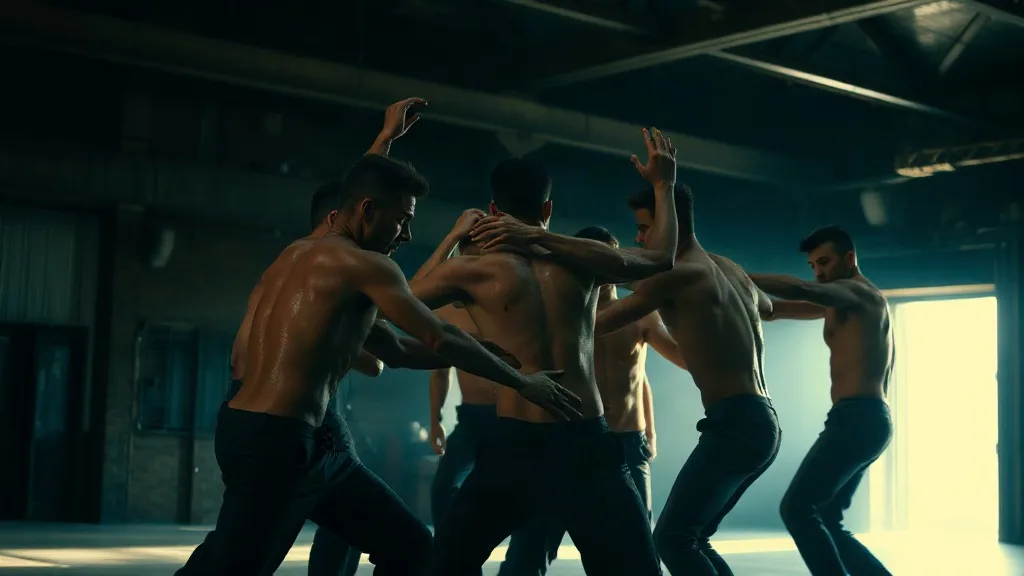
When Gener8ion's music video for 'Storm' first appeared online, it didn't just trend. It provoked. Within days, the clip, featuring a group of men moving in unsettling, hypnotic unison, had racked up millions of views and sparked debates far beyond the usual music-video chatter. At the center of the storm is Damien Jalet, the Belgian-French choreographer whose movement vocabulary has already left its mark on films like Suspiria and Dune. In a recent conversation, Jalet unpacked the ideas behind the video, and his words reveal why this particular piece has struck such a nerve in the cultural conversation about men and masculinity.
The Genesis of 'Storm': A Collaboration of Movement and Sound
Gener8ion, the project of French producer Surkin, is known for merging electronic music with striking visuals. For 'Storm,' he enlisted Jalet, whose reputation for crafting physically demanding, almost ritualistic group choreography made him an ideal partner. The result is a video that feels less like a traditional music promo and more like a short dance film, one that uses the human body as its primary instrument. Jalet explained that the process began with the music itself, which he described as having a 'primal' quality. He wanted to translate that sonic intensity into movement that would resonate on a visceral level.
The video features a cast of male dancers performing a series of interconnected sequences. They run, they fall, they rise, they cluster together and then break apart. There is no narrative in the conventional sense; instead, the piece builds an atmosphere of tension and release. Jalet noted that he was interested in exploring collective male energy, not as something monolithic or aggressive, but as something complex and often contradictory. The dancers' faces are largely impassive, yet their bodies convey a range of emotions: exhaustion, determination, solidarity, and an undercurrent of anxiety.
Deconstructing Masculinity Through Movement
So what is the message for men? According to Jalet, the video is not a didactic statement but an invitation to reconsider what male physicality can express. In many mainstream depictions, male bodies are either weaponized (action heroes) or sexualized (pop stars). Jalet's choreography sidesteps both. His dancers are not fighting an enemy or performing for a gaze; they are simply moving together, struggling with gravity, with each other, with themselves. This creates a space where vulnerability is not a weakness but a shared condition.
Jalet spoke about the importance of male vulnerability in his work. He observed that men are often taught to suppress certain physical expressions, to avoid appearing soft or uncertain. In 'Storm,' however, the dancers frequently collapse, crawl, and lean on one another. These actions are not framed as failures; they are integral to the piece's rhythm. By presenting these moments without irony or apology, the video suggests that strength can coexist with fragility. This is a subtle but radical message in a cultural moment where discussions about toxic masculinity are increasingly urgent.
The Role of the Group vs. the Individual
Another layer of the video's meaning lies in its tension between the individual and the group. The dancers often move as a single organism, their bodies synchronized in a way that evokes military drills or religious rituals. Yet there are moments when one dancer breaks away, only to be reabsorbed. Jalet explained that he was interested in the dynamics of male bonding, the push and pull between autonomy and belonging. In a society that often celebrates the lone wolf, 'Storm' proposes that men can find power in interdependence. This is not about losing oneself in the crowd, but about recognizing that collective movement can be a form of care.
The choreographer also touched on the physical demands of the piece. The dancers underwent intense training to build the stamina and precision required. Jalet praised their commitment, noting that their willingness to be seen in states of exhaustion and disorientation added to the video's authenticity. This behind-the-scenes rigor is part of what makes 'Storm' feel earned rather than merely provocative.
Why 'Storm' Resonates Beyond Dance Circles
Music videos often fade quickly, but 'Storm' has had an unusually long tail. It has been analyzed by critics, shared by dance enthusiasts, and even used in classrooms to discuss gender representation. Part of its staying power comes from its refusal to offer easy answers. Jalet doesn't tell men how to be; he shows them a range of possibilities. The video's ambiguity is its strength, allowing viewers to project their own experiences onto the dancers' struggles.
Moreover, the collaboration with Gener8ion's music is seamless. The track's industrial beats and eerie synths provide a scaffold for the choreography, and the editing amplifies the physical impact. The result is a piece that works on multiple levels: as a pure sensory experience, as a meditation on masculinity, and as a testament to the power of contemporary dance to communicate across boundaries.
In a year crowded with high-profile music videos, 'Storm' stands out because it demands something of its audience. It asks men to see themselves not as isolated performers but as part of a larger human choreography. And it asks everyone to reconsider what male bodies can say when they are allowed to be vulnerable, interdependent, and fiercely alive.
Frequently Asked Questions
What is the music video 'Storm' by Gener8ion about?
'Storm' is a music video that features choreography by Damien Jalet. It explores themes of male collective energy, vulnerability, and interdependence through a series of intense, synchronized movements performed by a group of male dancers.
Who is Damien Jalet and why is his work significant?
Damien Jalet is a renowned choreographer known for his work in contemporary dance and film. He has contributed to projects like Suspiria and Dune, and his style often involves ritualistic, physically demanding group choreography that challenges traditional representations of the body.
How does 'Storm' challenge traditional masculinity?
The video challenges traditional masculinity by showing men in states of vulnerability, exhaustion, and mutual support. Instead of portraying men as aggressive or invincible, it highlights their capacity for tenderness, interdependence, and emotional expression through movement.
What was Damien Jalet's inspiration for the choreography in 'Storm'?
Jalet was inspired by the primal quality of Gener8ion's music and sought to translate its intensity into movement. He was also interested in exploring the dynamics of male bonding and the tension between individual and collective identity.
Where can I watch the 'Storm' music video?
The 'Storm' music video is available on major streaming platforms like YouTube. It has garnered millions of views and continues to be discussed for its artistic and cultural impact.