
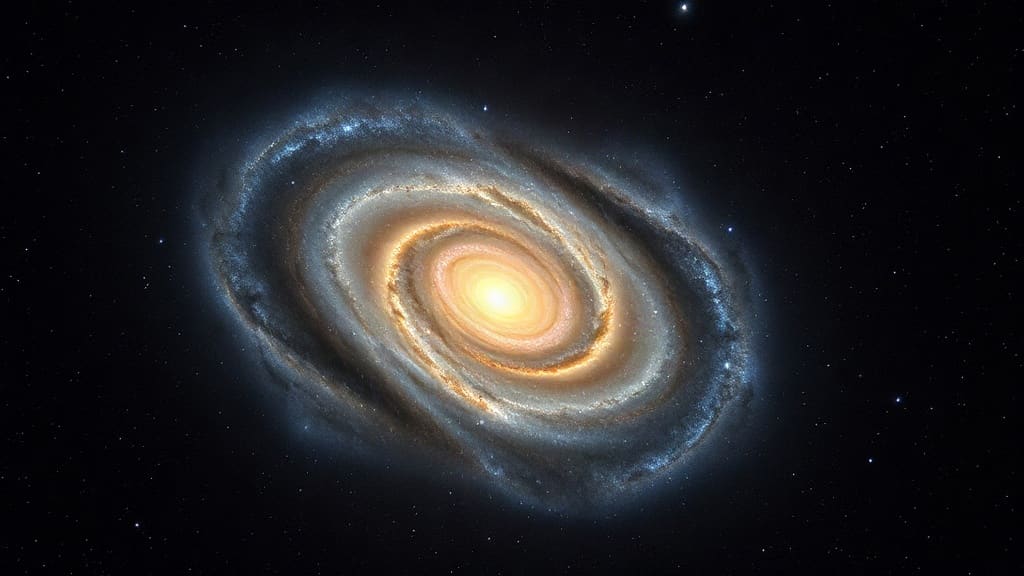
On September 30, 2026, the Astronomy Picture of the Day (APOD) turns its lens toward a cosmic oddity: Arp 78, a peculiar galaxy in the constellation Aries. For anyone who has ever looked up at the night sky and wondered about the strange shapes lurking in the deep, this image offers a compelling reminder that the universe is not a neat collection of perfect spirals and ellipses. It is a chaotic, dynamic place where galaxies collide, merge, and distort each other over billions of years. Arp 78 is a prime example of that cosmic violence, and its appearance in APOD is a chance to appreciate both its beauty and its scientific value.
APOD, a project run by NASA and Michigan Technological University, has been featuring a different image or photograph of our universe every day since 1995. Each entry comes with a brief explanation written by a professional astronomer, making it one of the most enduring and beloved science communication efforts on the internet. The choice of Arp 78 for the last day of September 2026 is fitting: it is a galaxy that challenges our tidy classifications and invites us to think about the processes that shape galaxies, including our own Milky Way.
What Exactly Is Arp 78?
Arp 78 is the designation for a galaxy listed in Halton Arp's Atlas of Peculiar Galaxies, a catalog published in 1966 that highlighted galaxies with unusual structures. Arp was interested in these oddballs because he believed they held clues about how galaxies evolve, particularly through interactions and mergers. Arp 78 is located in the constellation Aries, the Ram, which is visible in the Northern Hemisphere during autumn and winter evenings. The galaxy is also known by other catalog names, such as NGC 772, and it is a spiral galaxy that has been significantly distorted by gravitational forces.
What makes Arp 78 peculiar is its asymmetric appearance. It has a prominent, sweeping spiral arm on one side, while the other side appears more diffuse and disrupted. This lopsided structure is a telltale sign of a gravitational encounter with another galaxy. In this case, the culprit is likely a smaller companion galaxy, which has been tugging on Arp 78 and pulling out long streams of stars and gas. These tidal interactions are common in the universe, and they play a crucial role in the growth and transformation of galaxies.
Arp 78 is not just a pretty picture; it is a laboratory for studying how galaxies respond to external perturbations. Astronomers have observed that its spiral arms are not perfectly wound, and there are regions of intense star formation where gas has been compressed by the gravitational dance. These starburst regions glow brightly in ultraviolet and infrared light, revealing the birth of new stars. By studying Arp 78, researchers can test models of galaxy evolution and better understand the fate that awaits many galaxies, including our own Milky Way when it eventually merges with the Andromeda Galaxy in about 4.5 billion years.
The Science Behind the Image
The APOD image for September 30, 2026, is likely a composite or a deep exposure that captures the galaxy's intricate details. Such images are often taken by professional observatories, both ground-based and space-based, and they combine multiple wavelengths of light to reveal different physical processes. For example, visible light shows the distribution of stars, while infrared light traces dust and gas, and ultraviolet light highlights young, hot stars. By piecing together these views, astronomers can build a comprehensive picture of what is happening inside Arp 78.
One of the key features to look for in the image is the galaxy's extended halo and the faint tidal tails that stretch out into space. These tails are made of stars and gas that have been ripped from the galaxy during its interactions. They are extremely faint, so capturing them requires long exposure times and careful image processing. The fact that APOD is featuring such a detailed view of Arp 78 is a testament to the advances in telescope technology and the dedication of the astronomers who study these elusive structures.
Another point of interest is the companion galaxy that is causing the disturbance. In the case of Arp 78, the companion is likely a smaller galaxy that is not always visible in the same frame. It may be located behind or in front of the main galaxy, or it may be so faint that it only shows up in deep images. The interaction between the two galaxies is an ongoing process, and by observing it at different wavelengths and at different times, astronomers can piece together the history of the encounter.
Why Peculiar Galaxies Matter
Peculiar galaxies like Arp 78 are more than just cosmic curiosities. They are essential to our understanding of how galaxies form and evolve. In the early universe, galaxy collisions and mergers were much more common than they are today because galaxies were closer together and the expansion of the universe had not yet spread them far apart. By studying nearby examples like Arp 78, astronomers can get a glimpse of the processes that built up the large galaxies we see today.
Moreover, these interactions can trigger dramatic events. When galaxies merge, the gas and dust within them can be compressed, leading to bursts of star formation. In some cases, the central supermassive black holes can be activated, turning the galaxy into an active galactic nucleus (AGN) that shines brightly across the electromagnetic spectrum. Arp 78 itself may harbor an AGN, though it is not classified as a classic quasar. Studying its core can reveal how black holes grow and how they influence their host galaxies.
From a broader perspective, peculiar galaxies remind us that the universe is not static. Galaxies are dynamic systems that change over cosmic timescales. The Milky Way itself is a product of countless mergers and interactions, and it will continue to evolve. Observing Arp 78 is like looking into a mirror that reflects our own galaxy's past and future.
How to Observe Arp 78
If you are an amateur astronomer with a decent telescope, you might be able to spot Arp 78 in the constellation Aries. It has an apparent magnitude of about 10.3, which means it is within reach of a 6-inch (150 mm) telescope under dark skies. However, because it is a diffuse object with low surface brightness, it can be challenging to see. You will need a dark site away from city lights, and you should allow your eyes to adapt to the darkness for at least 20 minutes.
To find Arp 78, start by locating the constellation Aries. The brightest stars in Aries are Hamal (Alpha Arietis), Sheratan (Beta Arietis), and Mesarthim (Gamma Arietis). From Hamal, star-hop to the faint stars that lead to the galaxy's position. It is located roughly 2 degrees north of the star 19 Arietis. A star chart or a planetarium app will help you pinpoint it. Once you find it, look for a small, elongated smudge of light with a brighter core. The spiral arms may be difficult to see visually, but with averted vision and patience, you might detect some structure.
For those who prefer astrophotography, Arp 78 is a rewarding target. Long exposures will reveal the tidal tails and the faint outer regions. You will need to stack multiple images to reduce noise and bring out the details. The challenge is worth it, as the resulting image can be strikingly beautiful and scientifically informative.
Frequently Asked Questions
What is the significance of Arp 78 being featured on APOD?
APOD selects images that are both visually stunning and scientifically interesting. Arp 78 fits both criteria: it is a peculiar galaxy that showcases the dynamic nature of the universe, and it provides a chance for the public to learn about galaxy interactions. Its feature on September 30, 2026, helps keep astronomy accessible and engaging for a broad audience.
Can I see Arp 78 with a small telescope?
Yes, but it requires dark skies and a telescope with at least a 6-inch aperture. It will appear as a faint, elongated patch of light. Larger telescopes (10 inches or more) will show more detail, including hints of the spiral structure and the companion galaxy.
What causes the peculiar shape of Arp 78?
The shape is primarily due to gravitational interaction with a smaller companion galaxy. This interaction has distorted the spiral arms and triggered star formation in some regions. Over time, such interactions can lead to mergers, completely changing the galaxy's morphology.
Is Arp 78 visible from both hemispheres?
Arp 78 is located in the constellation Aries, which is best seen from the Northern Hemisphere during autumn and winter. Observers in the Southern Hemisphere may have difficulty seeing it, as it is close to the celestial equator and not very high above the horizon.
How does Arp 78 compare to other peculiar galaxies?
Arp 78 is one of many galaxies in Arp's atlas, each with its own unique distortions. Some are more extreme, like the Antennae Galaxies (Arp 244) or the Mice Galaxies (Arp 242), which are in the midst of violent mergers. Arp 78 is relatively less disrupted but still shows clear signs of interaction, making it an excellent example of the early stages of a merger.
As we admire the APOD image of Arp 78, we are reminded of the grandeur and complexity of the cosmos. It is a snapshot of a process that takes millions of years, yet it captures our imagination in an instant. Whether you are a seasoned astronomer or a curious stargazer, Arp 78 invites you to look up and wonder.